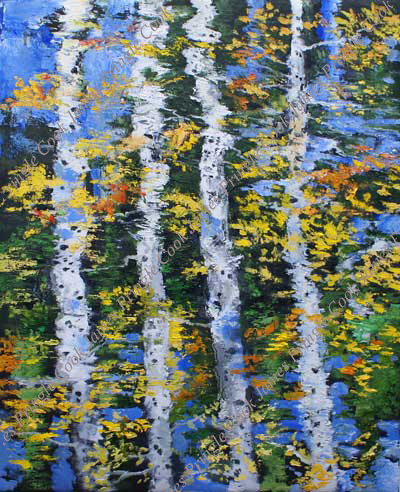
Four Aspen Reflection-Autumn © 60"x48" oil on linen
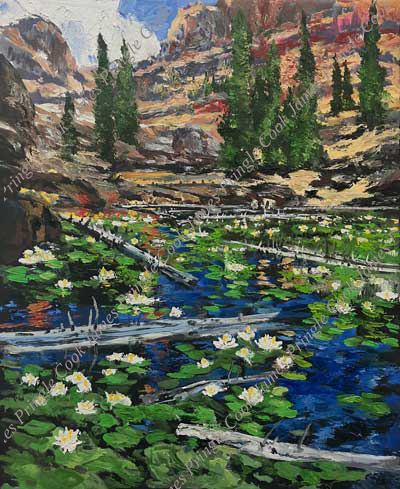
Lily Lake-Spring © 60"x48" oil on linen
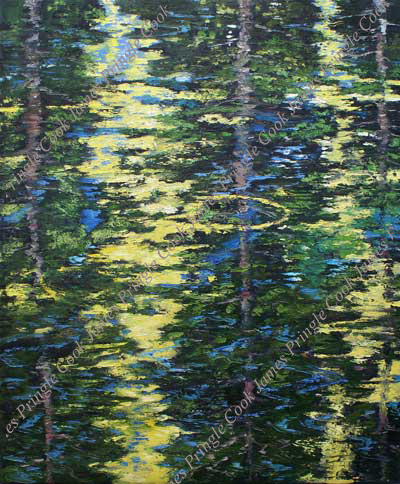
Rise Ring-Sunset © 66"x54" oil on linen
Mark Sublette The Medicine Man Gallery in Tucson, Arizona represents James Pringle Cook
Four Aspen Reflection-Autumn © 60"x48" oil on linen
Lily Lake-Spring © 60"x48" oil on linen
Rise Ring-Sunset © 66"x54" oil on linen
I have always admired James Cook for his tenacity. He consistently explores rich visual ideas embedded in nature in an uncompromising, individualistic manner. His work is powerful, raw, expressive, highly ordered, and deals with landscape viewed through its' rich history, especially our American traditions.
James Cook's artistic world begins in Tucson, Arizona, where he lives with his family. Surrounded by mountains, rocky cliffs, big skies, valleys with large spruces and raginging rivers, his environment is filled with diverse subject matter that is changing all the time. From day to night, through the seasonal changes, to the encroachment of cities and the industries they produce, James Cook takes his inspiration. When he travels, he finds beauty and the extraordinary in the sights around him. To understand the land for its beauty and its rawness, for its mysterious secrets and its potential, are the qualities that rivet you in James' work.
The best subject for an artist is what is well known and familiar. When we are able to return time after time to reflect, judge, and experience, we are then able to present an interpretation that is new and reflective. There is a responsibility to being a landscape artist. Landscape involves images that are beautiful in their intimacy and in their heroism. Landscape artists present a beauty that reflects the effects on nature by the human presence. Such images heighten our awareness of our surrounds and allow us to ponder, question, and seek answers. Our environment is crucial to our very existence. James Cook has the confidence and vision to paint large-scale works that are compelling, energetic, and filled with ideas. He offers a space you enter with pure excitement.
James Cook belongs to the great tradition of expressionism. This reflects the passion he has for his subject matter, and his choice of materials. An artist chooses his materials to create an image that fuses memory with observation. Brushes, media, oil paint and canvas engage the viewer in the expressive mood of the painting. The very physicality of his painting captures the motion, the air, the light and the feeling of a moment in time in the landscape. The rushing clouds, light flickering on and through trees, the pounding of raging waters over boulders and rocks all reflect a vision that moves into the viewer's soul and the beating of the heart.
Artists no longer live within established traditions, they need to re-invent and consider the future. James Cook paints a vision for the future that is filled with poignancy and adventure. His paintings are environmental and his themes of life and extinction are all themes that are close to me. He remains as daring as artist as anyone I know.
Barry Gealt is a distinguished American painter and
Professor Emeritus, Indiana University, Bloomington, Indiana
Written for the JAMES COOK catalog. "The Painted Image"
Beaux-arts des Amériques, Montréal, Canada
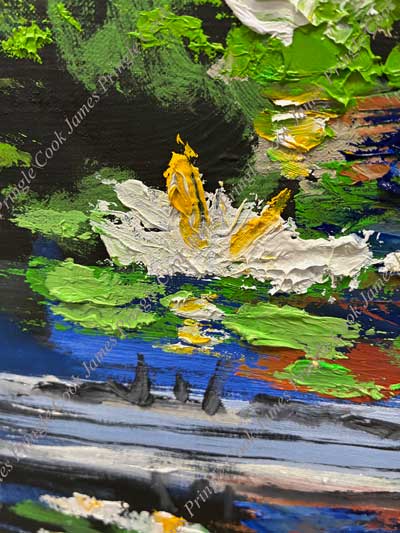
"Detail of Lily Lake-Spring"
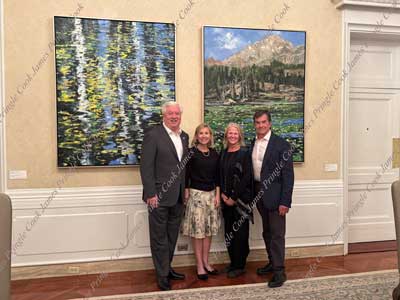
"Ambassador Glass and his wife with Gail Severn (Gail Severn Gallery, Ketchum, Idaho) and friend in front of James Pringle Cook's paintings at the American Embassy in Tokyo, Japan."
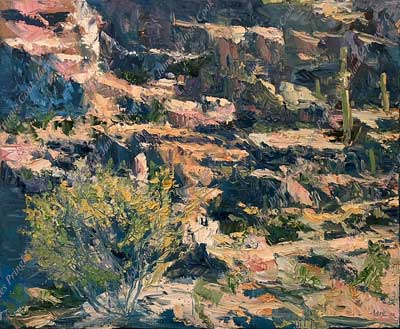
Lazar Canyon #1 24"x36" © oil on linen
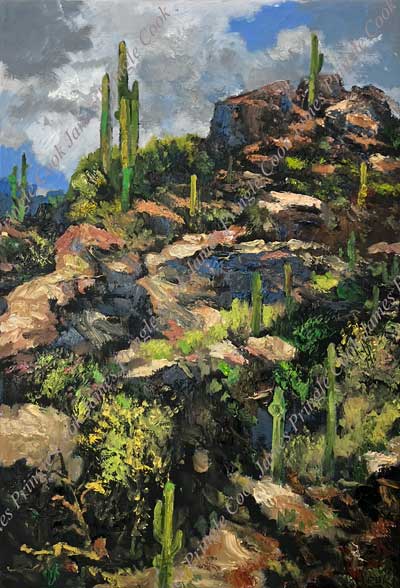
Lazar Canyon #2 36"x24" © oil on linen
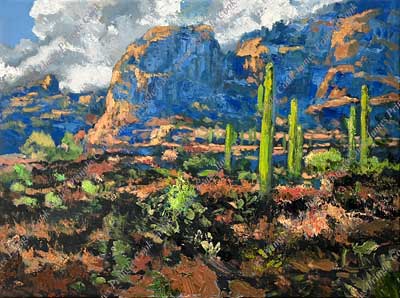
Lazar Canyon #3 24"x36" © oil on linen
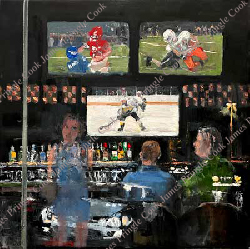
Monday Night © 36"x36" oil on linen
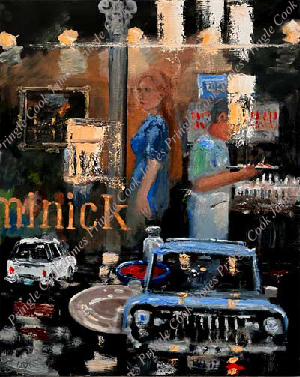
Dominick © 60"x48" oil on linen
Landscape painting has been around for thousands of years - from Minoan Greece in Western culture to the ancient pure landscapes in Chinese art. The land, breathtaking in its beauty and awesome in its power, is something we all understand to be bigger than ourselves...a fact that has been driven home quite effecctively recently by the earthquakes in Haiti and Chile and the volcanic eruption in Iceland that made us all pause for awhile - many of us in airports far from home and loved ones. In the face of possible injury or even death, this duality of wonder and fear inspires both novice and experienced adventurers to navigate the oceans, to trek through field and forest, to scale the highest peaks. Artists are no less exempt from this quest as they continue to explore ways to capture the many features and moods of the vast, brash, colourful and untamed landscape.
Here in Canada, where the Group of Seven threw down the gauntlet and changed the direction of landscape painting to reflect the reality that is North America, we present the work of James Cook whose paintings are foursquare in the best tradition of American landscape painting. Whether landscape or cityscape, they are big and gutsy - full of bravura and virtuosity - with lavish, vigorous, and confident brushstrokes that are almost musical in their composition. You cannot fail to feel the expressive power of the paintings. They complement and bring us closer to the true grandeur and awesome splendour of the subject.
Lucienne Lefebvre Glaubinger
Jacqueline Hébert Stoneberger
Beaux-arts des Amériques, Montréal, Canada
FS: There are numerous art books about American landscape paintings. Do you have the sense that you are painting something that we are losing or that is threatened?
JPC: I was reading something a couple of days ago about a painter painting a moment which passed. That place did not go away, it just changed. I have painted some places for thirty years, and they have changed, but they did not go away.
________________________________________________________________________________________________
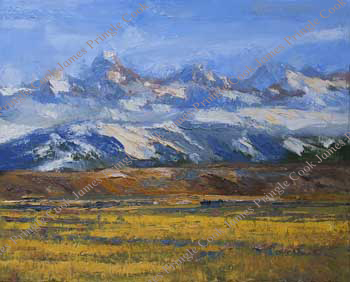
Teton Valley #1 © 30"x36" oil on linen
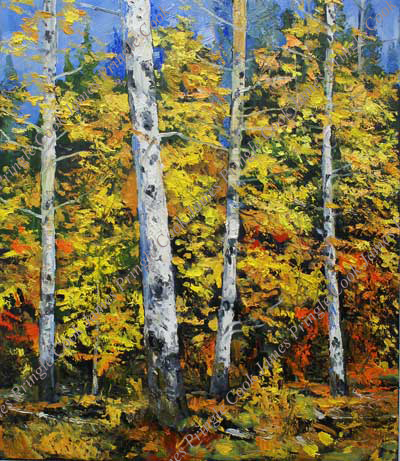
Mt. Lemmon-Aspen © 36"x42" oil on linen
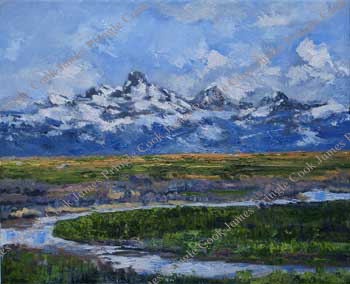
Teton Valley #2 © 30"x36" oil on linen
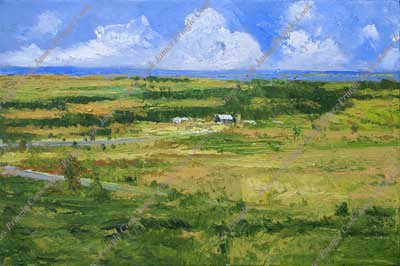
K 99 #2 © 24"x36" oil on linen
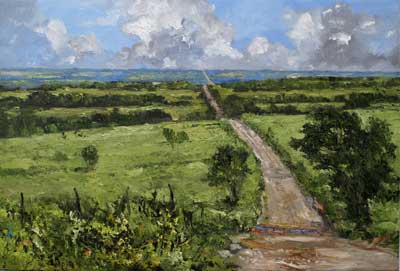
Echo Cliff Study #4 © 40"x60" oil on linen
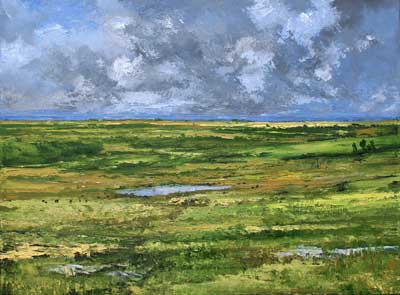
Skyline Angus © 36"x48" oil on linen
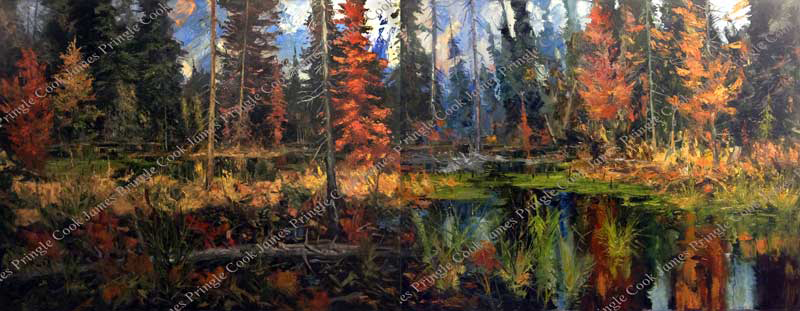
Trapper's Lake © 68"x168" oil on linen
CP: What place does 'gesture', the vitality of mark making play in your own work, and what can this express to the viewer?
JPC: I have tried to find a form of painting that speaks to me from the canvas the way nature stimulates my eye. I find the physical and plastic qualities of paint very stimulating. The challenge is to give to the painted surface the ring of truth and not just the slap dash of gesture.James P. Cook's, daughter, Ellen A Cook, is a poet as well as an artist;
listen to her poems on her YouTube channel!
See also: DeAnn Melton, Ellen A. Cook, @EllenACook, JP Ranch Publishing
©James Pringle Cook, all rights reserved / Please contact me for prices